
 Connect
Press release

Press release
Eclipse Energy and Wood to Scale Hydrogen Production from End-of-Life Oil Fields


Discover why Mantel Capture, the leading provider of energy-efficient and cost-effective carbon capture, selected Wood as their preferred technology provider, and what this means for the first-of-its-kind commercial deployment of the technology within Canada’s energy landscape.
Since 2022, Wood and Mantel have approached high‑temperature carbon capture from first principles, starting from the underlying physics and chemistry rather than improving existing systems. By designing from these fundamental truths of combustion and capture, Mantel has advanced innovative concept into deployable, commercial‑scale design.
High temperature carbon capture can eliminate the cooling energy penalty
Fired-equipment integration unlocks efficiency gains in hard-to-abate industries
Wood and Mantel are deploying a first commercial project in Canada
Conservation of heat remains one of the most difficult decarbonisation challenges for carbon capture. Conventional post‑combustion systems typically require flue gases to be cooled before capture. Mantel’s capture system is different. Their unique operating temperature reduces the amount of heat wasted, making it a good fit for industrial applications. Heat loss penalties in conventional capture systems are particularly significant in assets designed for continuous, high‑reliability operations, such as boilers, fired heaters and once‑through steam generators (OTSGs). By reducing complexity and cost, the Mantel solution removes a significant obstacle for carbon capture deployment on industrial fired equipment.
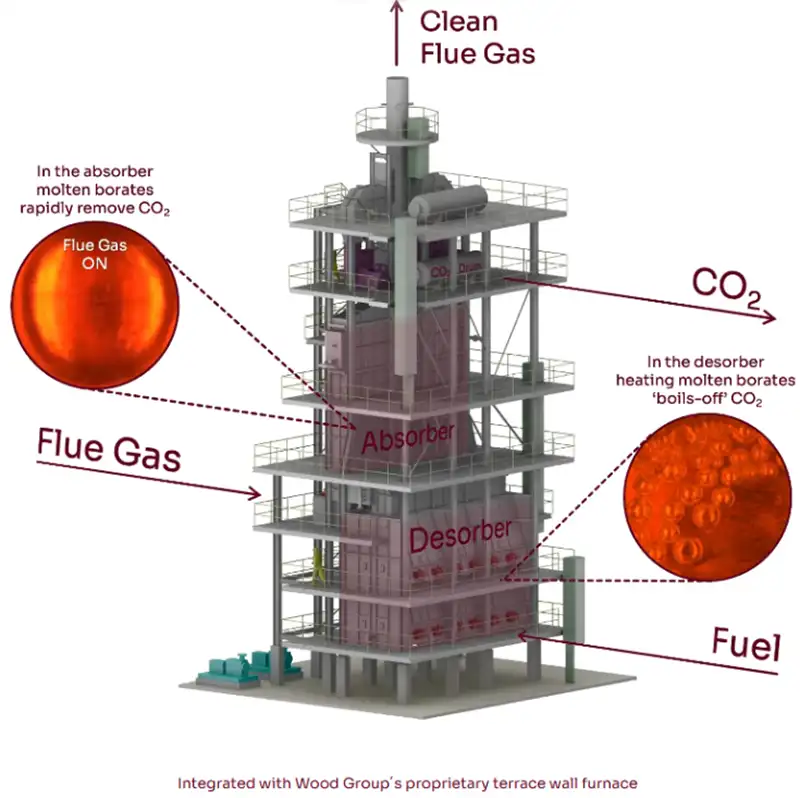
Using a medium that operates as a liquid at elevated temperatures, Mantel’s molten salt carbon capture technology is designed to capture CO₂ closer to the combustion process, additionally modifying the thermal cycling temperature to provide more utilisable heat, therefore avoiding the energy penalty.
The opportunity is compelling for operators, but only if the technology can be integrated safely and predictably into existing thermal systems.
Wood’s early engagement with Mantel was driven by technical curiosity. Through the acquisition of legacy Foster Wheeler, Wood brings more than a century of original equipment manufacturer (OEM) expertise in high temperature process equipment such as fired heaters, delayed cokers, boilers and other thermal applications. Recognising the significance of these types of equipment and deep technical knowledge, Wood was actively exploring decarbonisation pathways.
The teams recognised the disruptive potential of a system capable of capturing carbon at high temperatures, eliminating the energy penalty associated with cooling combustion gases before capture and keeping the heat rejected at temperatures that are practical to produce steam.
Mantel offers a thermally efficient, cost-effective pathway to decarbonisation for thermal processes across various sectors, aligned with Wood’s mission to support clients through the energy transition.
Wood’s subject matter experts in New Jersey, Houston, Atlanta, Calgary and London, collaborated seamlessly with Mantel’s U.S. and Canada-based teams to offer solutions to clients in hard-to-abate sectors.
From the outset, the team’s design kept the end goal in mind to deliver a product that will be operated and maintained safely and efficiently.
Joint working groups concentrated on the interfaces where risk typically accumulates. Workshops and iterative design reviews brought together fired‑equipment specialists, process engineers, mechanical engineers and control engineers to address integration challenges directly. Together, the companies progressed the concept towards a scalable and deployable solution.
A key outcome was a shared understanding that carbon capture is most effective when designed for the heat source, rather than added downstream. Wood’s experience with OTSGs, fired heaters, heat recovery steam generators (HRSGs) and their proprietary Terrace Wall® furnace technology informed decisions on layout, geometry, materials and control philosophy. This ensured capture integration supported thermal performance.

The collaboration was formalised through a Memorandum of Understanding (MOU) in May 2026. Mantel appointed Wood as its Preferred Technology Provider for fired equipment, reflecting trust in Wood’s ability to integrate high-temperature capture into thermal systems.
Together, both organisations share a clear vision of how combining Mantel’s advanced carbon capture innovation with Wood’s industrial firing expertise creates a differentiated commercially viable solution for hard-to-abate sectors.

Today, the collaboration has advanced into delivery. Wood was also selected to execute the front‑end engineering design (FEED) for a commercial application of Mantel’s molten‑borate carbon capture technology at a confidential steam assisted gravity drainage (SAGD) site in Western Canada.
Acting as overall integrator, Wood is responsible for aligning and integrating the licensor’s design, vendor packages, tie‑ins and site‑specific constraints into a cohesive, execution‑ready FEED design. The design targets include:
For SAGD applications, the high operating temperature of Mantel’s molten borate system enables recovery of the heat rejected during salt cooling to generate steam. This minimises wasted heat input otherwise required to reheat the salt to the CO₂ desorption temperature. The synergy is particularly powerful as steam generation is the primary source of CO₂ emissions in SAGD operations.
This project represents a critical step from pilot to commercial scale, demonstrating how carbon capture can be integrated directly into core industrial processes while improving overall system efficiency.
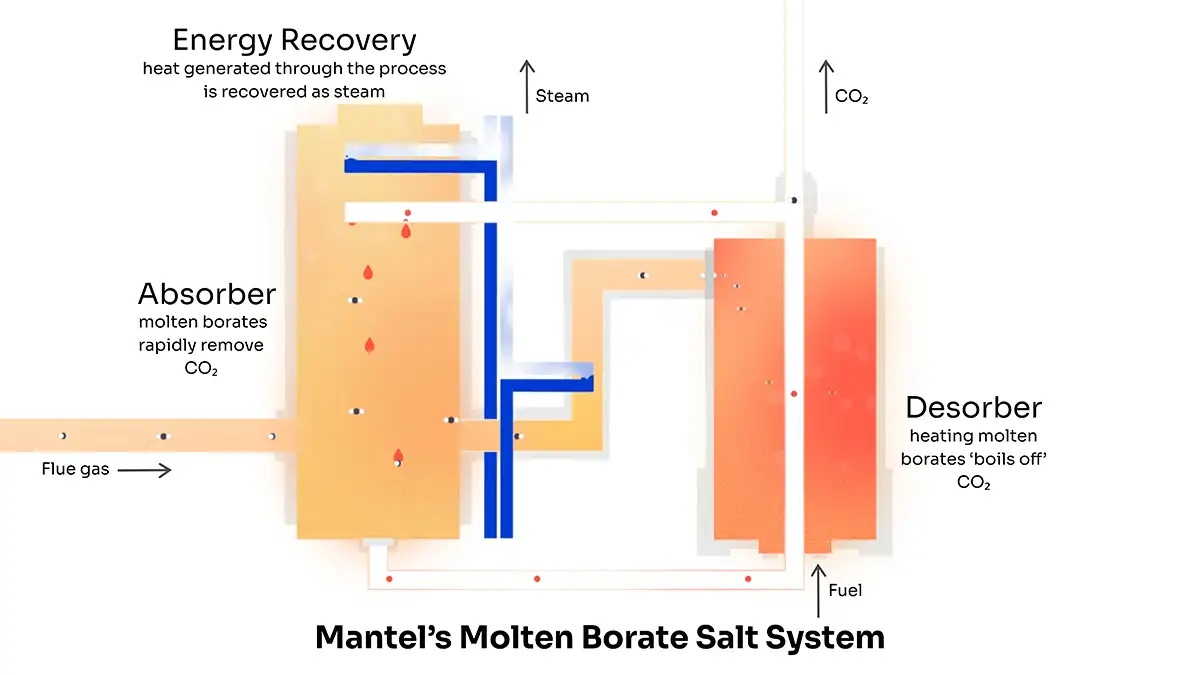
A first-of-its-kind high-temperature carbon capture project for SAGD operations in Western Canada.
As carbon capture technologies and applications mature, asset owners are focused on predictable integration, reliable operation and repeatable outcomes. Several lessons have emerged from the Mantel–Wood collaboration:
Collaborations with disruptive technology providers like Mantel offer a practical pathway to decarbonising at a commercial scale. Mantel’s platform is naturally adaptable, leveraging a wide range of CO₂ emitting equipment configurations to extend carbon capture well beyond a single use case or sector. This flexibility opens new possibilities across multiple industries, allowing operators to reexamine existing assets and their options for carbon capture.
This next generation of carbon capture technology is poised to reshape how we design, operate and future-proof industrial systems and will help define a carbon capture marketplace driven by performance, scalability and lasting impact.