
Article
Article
What does good maintenance execution look like in practice?


The abundance of natural gas in the US along with the rising global demand of LNG, particularly in Asia, is establishing a strong incentive for the development of innovative solutions to export LNG from the US.
Onshore LNG facilities have been the predominant industry solution since the 1960s for the import or export of LNG, particularly for baseload capacities. But with the constant flux in market supply and demand dynamics, floating LNG (FLNG) facilities (offshore and near-shore) are becoming increasingly prevalent worldwide with a focus on lowering project costs, improving operating efficiencies and reducing execution schedules.
However, a new, viable alternative has emerged, inspired by both FLNG and the fixed multi-platform, bridge-connected production facilities you find offshore.
Wood is proud to have delivered front-end engineering design (FEED) for the world’s first offshore platform-based natural gas liquefaction and storage facility for Honghua Offshore and EnTX GasTek Global Ltd.
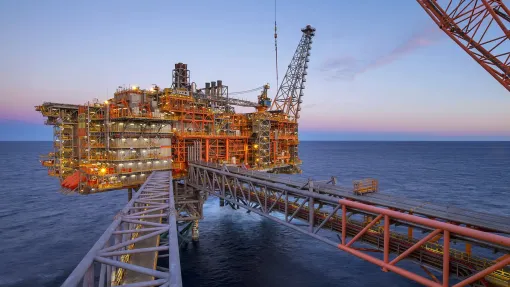
The Platform-based LNG solution (PLNG) is a unique proposition as it is the special combination of a well-established, industry-wide offshore solution – the fixed jacket supporting topsides processing facilities – with proven LNG processing equipment operating globally.
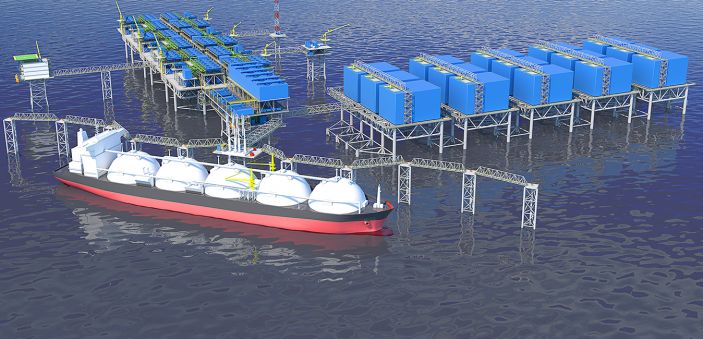
The project in the West Delta area, known as LNG 21 is initially designed to include six modular natural gas liquefaction trains, each with a nameplate capacity of .833 MMtpa (million metric tonnes per annum) with the potential of up to 1.02 MMtpa each, providing total optimal capacity of 6.1 MMtpa of LNG. Liquefaction modules will use field-proven Baker Hughes GE technology. FSB-type aluminum storage tanks, developed under license from General Dynamics, will be capable of holding 300,000 cubic meters of LNG for off-loading to LNG carriers. All modules will be installed on conventional fixed platforms designed by Wood
This project is designed as a world-first fixed-platform natural gas liquefaction facility with uncongested open-water access for LNG carriers, free of the coastal footprint that burdens shore-based facilities. In addition, the project resides in the center of one of the nation’s top natural gas production basins, providing easy access to abundant gas supplies, with opportunities for off-take partners to diversify upstream for even greater supply certainty and price protection.
While it could create the opportunity to address mid-scale LNG import and export developments, with particular focus on shallow water locations, the engineering and design is not without its challenges. One of the main design challenges is the right balance between deck and topsides configuration and jacket size, along with ease of transportation and installation while considering the size and weight of the topsides (i.e. LNG storage), soil and metocean conditions, and availability of global and local transportation and installation vessels.
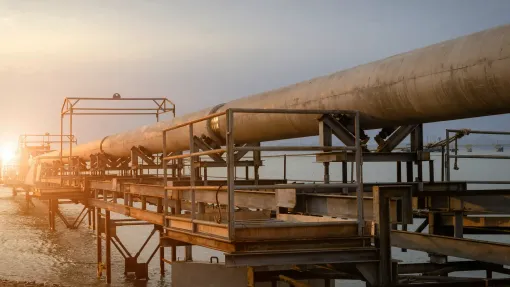
Within the pioneering engineering and design scope our team had to consider the onshore gas pre-treatment plant configuration and layouts, general utilities, feed gas processing and compression and transportation and delivery via repurposed pipelines from the existing onshore facilities in Louisiana to the LNG facility 10 miles offshore.
We were already on first name terms with the project having successfully completed the pre-FEED work, optimizing the design to meet U.S. Safety and Environmental Regulations, as well as enabling the client to define the siting and installation strategies.
As a team we worked diligently to develop a visionary end result, which became a multiple fixed platform, bridge-connected scalable complex engineered to host and support a variety of LNG processing and storage systems on individual or multiple dedicated platforms. The unique PLNG approach offers a safe, cost-effective and time compressed schedule in executing mid-scale LNG developments between at-shore, near-shore and deepwater floating vessels.
The facility will be sited in the Gulf of Mexico in water depths of less than 200 feet (60 meters) providing flexible processing capability and LNG storage capacity to meet project needs.