
video
Webinar

Webinar
Solar plant underperformance (partner webinar)
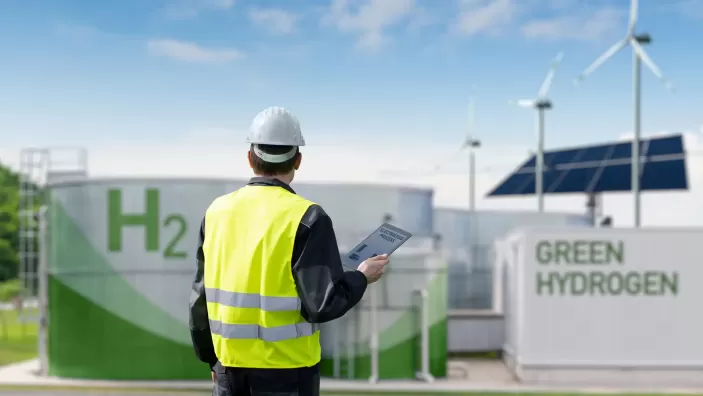


The UK government has set itself substantial green hydrogen ambitions, aiming for 10 gigawatts (GW) of low-carbon hydrogen by 2030. However, while there are currently many hydrogen feasibility projects in play across the country, only a few have reached the final investment decision (FID). In its Hydrogen Insights 2023 report, the Hydrogen Council reported that only 7% of investments in clean hydrogen on a global level have passed FID. Therefore, if hydrogen is to fully realise its potential in facilitating a swift energy transition, we must address the pressing challenges currently blocking its ability to scale up at an early phase.
Hydrogen has been a critical feedstock for producing ammonia and key to the chemical, food, and pharmaceutical industries throughout the past century. With mounting pressure to decarbonise, industries such as steel and cement manufacturing are now also turning to hydrogen as a solution to help cut their carbon emissions.
A readily available alternative to coal and other carbon-emitting fuels, hydrogen’s high energy density will be necessary for high energy-demanding industrial processes. Because of this, streamlining the process of implementing hydrogen into the industry has become a priority for markets wishing to decarbonise.
Sectors heavily reliant on grey hydrogen at present are also on track to switch to green hydrogen. Long-range transport and industries currently reliant on fossil fuels are targets for switching to green hydrogen. Fertiliser production alone is expected to require around 50 million tonnes of green hydrogen per year by 2050, according to the Energy Transition Council. When totalling this shift, it's estimated that to fulfil industrial demand by 2050, we will need to generate more than 500 million tonnes of green hydrogen in the next two decades.

The costs associated with meeting this demand will inevitably be high. Green hydrogen remains an expensive alternative to traditional fuelling methods largely due to the cost of production, which shows little signs of decreasing. For large-scale electrolytic hydrogen production, those falling in the category of GW+, we are currently looking at necessary CAPEX investments in the billions of dollars.
According to the Hydrogen Council, green hydrogen projects in the pipeline are expected to require $320 billions of investment, however, only $29 billion has been committed so far. To resolve the bottlenecks associated with funding green hydrogen, reductions must be made to the cost of electrolysers by increasing efficiency, scale and using cheaper materials. Decoupling renewables from gas in the electricity market to reflect the low costs of wind and solar in the prices of electricity will also be key.

Producing decarbonisation solutions through hydrogen that are sustainable is necessary. Therefore, we must be designing future-proof projects that will not contribute to climate change further. With increasing water scarcity, the current abstraction licence for water is 50m3/day in Scotland, with the volume being even less in England and Wales. This is barely enough to generate an 8-megawatt (MW) electrolysis project. To overcome this, future designs will have to consider the use of seawater and wastewater from nearby plants, as it is unlikely that large projects will be allowed to use surface or groundwater for hydrogen purposes. Developers will also have to prioritise establishing electrolyser technologies with less stringent water purity requirements as less potable water becomes available.
The second challenge comes with fugitive hydrogen emissions as it is currently not fully understood what the global warming potential (GWP) of hydrogen is. While hydrogen is not a direct greenhouse gas, it indirectly affects chemical reactions responsible for climate change, making it crucial for future projects to account for hydrogen emissions to ensure their operation is truly low carbon.

Across the energy mix, the supply chain is struggling to keep up with increasing demands. The supply chain to support the hydrogen economy is complex and wide-ranging with a variety of factors which have caused bottlenecks in recent years.
It’s a classic chicken and egg situation, there will be no supply without demand but there won’t be demand if there is no supply. Some countries have invested more in hydrogen use cases such as hydrogen refuelling stations than others and therefore have a greater demand for hydrogen. Because macroeconomic conditions and the abundance of renewable energy resources make some locations relatively more cost-efficient to produce hydrogen than others, there may be a mismatch between the most efficient place to make the hydrogen and the place that has the greatest demand for hydrogen, hence, a global supply chain.
The large demand and low supply of ‘hydrogen ready’ equipment is another factor causing delays in the production and transmission of hydrogen. Some existing designs from fossil fuel production and distribution can be optimised and potentially re-used. Still, it is currently not clear when existing pipelines will become available for hydrogen making it potentially easier to purpose-build equipment for the fuel. Ideally, the required infrastructure will be built in parallel to growing hydrogen demand at decreasing costs to ensure that by 2030 hydrogen can be produced in large quantities. Failure to start establishing this infrastructure now will be detrimental to allowing hydrogen production to evolve at a steady pace.
When it comes to successfully launching green hydrogen facilities, early engagement is the key. Local communities and decision-makers must be included in pre-pre application discussions, with regulators and the supply chain to secure appropriate locations for green hydrogen hubs to be created. A lack of public engagement could be damaging to the success of these projects. A recent example of this was the ‘Hydrogen village’ in Redcar which was ultimately abandoned after local opposition late last year. Insufficient local hydrogen production for the trial which aimed to replace the home gas supply, coupled with the outcry of residents against the scheme saw it ditched.
Cases such as this emphasise the importance of engaging in pragmatic discussions on the significance of decarbonisation and the effect climate change has and will have on the world if we fail to act now. Wood demonstrated the value of engaging technical advisory experts early in the process when it executed the H100 project for gas distribution network operator, SGN. Wood’s consultants explored the feasibility of supplying green hydrogen for domestic heating at the proposed site Machrihanish, on Scotland’s west coast. Through detailed analysis of the social, commercial, and technical issues associated with the design and construction of the Machrihanish site, Wood identified the best solution to progress the proposed green hydrogen production and storage facility. Our technical advisors also mapped the distribution network route to meet a 300-home equivalent hydrogen heat network, ensuring the security of supply to each home.
A lack of clarity on regulations and guidance for developers and decision-makers during the early planning process for green hydrogen applications is another pressing issue. Governments will play a crucial role in enabling the fuel to scale up, however, if there are no clear pathways for developments in place it will make this far less likely. Clarity on how existing policies can apply to hydrogen projects is severely lacking. Beyond this, there is currently still no green hydrogen-specific best available techniques (BAT) in the UK. Currently, different information for chemical, gas and power generation industries must be combined to apply.
The potential of green hydrogen as a key player in the UK’s energy transition is clear. Its low-carbon properties make it an attractive solution for the world’s growing clean energy needs. However, the current pace of progress in applying this promising fuel to industrial practice is insufficient. The pressing engineering, social and financial challenges facing the sector are significant hurdles which we must overcome.
To truly advance green hydrogen, early and active engagement is crucial. Governments, industry experts, communities and investors must work together to address these challenges and accelerate the adoption of green hydrogen. Only then can we unlock its full potential and make it a cornerstone of achieving a low-carbon future.